Shopify Editions Spring 2026, Decoded: Behind 150+ Updates, Only One Storyline Matters for Global Ecommerce Brands
Hi, I’m Riven — I write about cross-border DTC growth in the age of AI search.
In mid-June 2026, Shopify shipped its Spring ‘26 Edition — officially “150+ updates,” under the banner of “Commerce Everywhere.” Every time Editions drops, the agencies and LinkedIn feeds light up: more AI, more checkout, more POS… until the sheer feature count goes numb.
Let me be honest with you: out of these 150+ updates, there’s really only one storyline. Get that line, and you save two hours scrolling the feature list — and you understand exactly where to push your store over the next 12 months. This piece nails it down.
 Shopify Editions Spring ‘26 theme “Commerce Everywhere” · source: shopify.com/editions/spring2026
The one-line takeaway: the shelf is moving from “pages” to “conversations”
For the last decade, the commerce “shelf” was the web page — your storefront, your product pages, that blue link on Google’s results page. Sellers competed on SEO, ads, and landing-page conversion.
What Spring ‘26 Edition is really doing is moving the shelf from web pages to anywhere people shop — especially the AI chat box. As Deann Evans, Managing Director EMEA, put it: merchants need to make their products show up “accurately and naturally everywhere,” and Shopify wants to “set the standard for how AI agents discover products.”
In other words: Shopify is betting that the next generation of shopping happens inside ChatGPT, Copilot, and Google AI Mode — not only on the results page and your own site.
This is exactly what I argued in my Hangzhou keynote in May (see my other piece, Shopify GEO & Agentic Commerce): the traffic entry point is shifting from the search results page to AI conversations. This Edition is Shopify turning that thesis into 150 products.
Below I break it down into the four blocks that actually matter for cross-border sellers — then my verdict and an action checklist.
Block 1: Agentic Commerce — your products are about to get “listed” inside AI ⭐
This is the absolute centerpiece of the whole Edition, and the part you should spend the most time on.
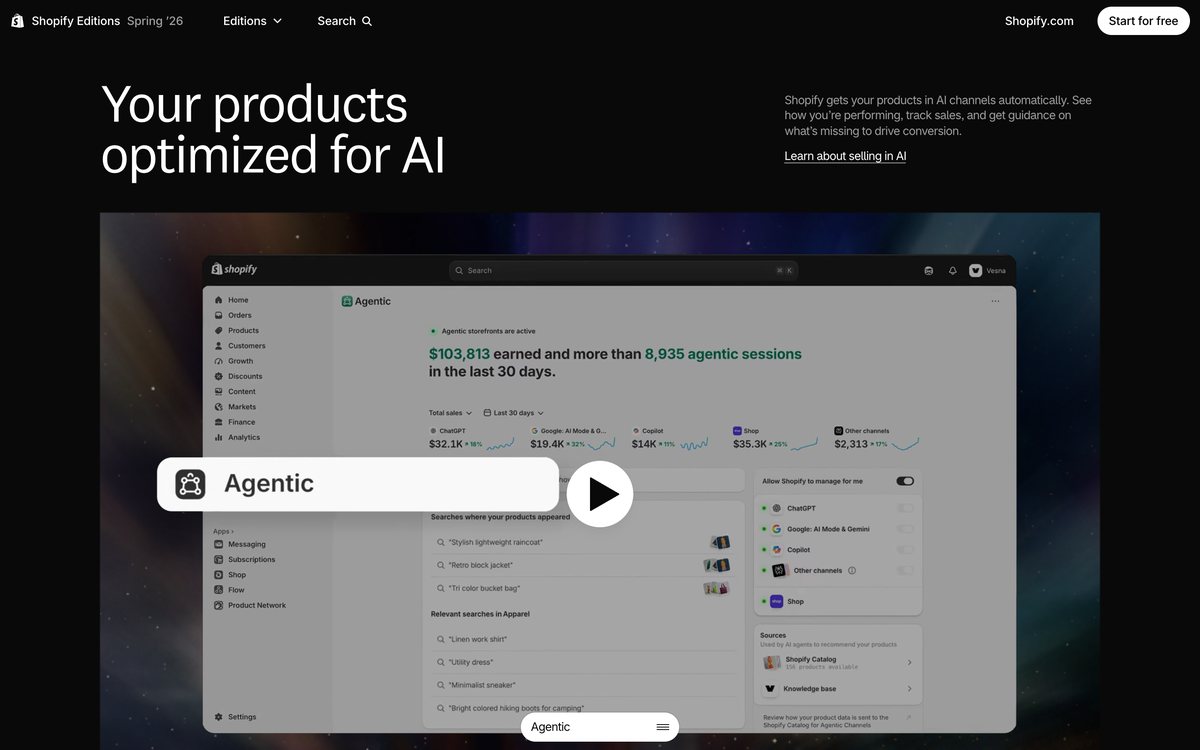 Shopify “Your products optimized for AI” — the admin surfacing sales and sessions driven by agentic shopping · source: Shopify Editions
1. Shopify Catalog: feeding your product data to the AI
Shopify now automatically standardizes and enriches your product data, then syndicates it to the various AI channels. The official number: data structured and syndicated by Shopify drives 2× the conversion in AI chats. This Catalog reportedly already serves “billions of products.”
In plain words: before, how the AI described your product was entirely up to whatever it scraped and guessed; now Shopify hands the “model answer” straight to the AI.
2. Catalog API + Universal Commerce Protocol (UCP)
- Catalog API lets AI agents discover, recommend, and sell your products. It also supports image search (pass an image, get visually similar products) and bulk lookup (real-time data for up to 50 SKUs in one request).
- Universal Commerce Protocol (UCP) is an open protocol that turns Catalog, Cart, and Checkout into standardized MCP interfaces, so any developer can build agentic shopping experiences.
Here’s what I want to underline: UCP is Shopify grabbing the “infrastructure standard” for AI commerce. Whoever defines the protocol owns the foundation of the next shelf. It’s the same playbook as Shop Pay claiming the “checkout standard” years ago.
3. Checkout, living natively inside AI and social
- Checkout on more surfaces: buyers can complete purchases right inside Copilot and Meta ads — “buy directly in chat.”
- Sponsored Products: you can earn revenue / advertise inside agentic experiences (developer preview coming soon) — the ad slots of the AI shelf are taking shape.
- Agentic Plan: even non-Shopify businesses can sync products into Shopify Catalog. Shopify wants to be the entry point for AI commerce as a whole, not just serve its own merchants.
🔑 Riven’s read: this is the “hardware layer” of GEO
I write constantly about GEO (Generative Engine Optimization) — how to get your brand mentioned, cited, and recommended inside AI answers.
Many assume GEO is purely a “content-side” job. Spring ‘26 Edition shows you that Shopify is already building the “hardware layer” of GEO — Catalog is the data pipeline, UCP is the protocol standard, checkout-in-chat is the conversion loop.
Content side (GEO) + data side (Catalog/UCP) = the full AI-shelf chain. Structured data the AI never recommends is useless; great content with messy product data won’t get the AI to route orders to you either. Both legs have to move.
Block 2: Sidekick + Autopilot — one person, running a whole team
If agentic commerce is the “outward” shelf migration, this block is the “inward” one — Shopify has stuffed AI into every corner of the admin, so small teams can do the work of big ones.
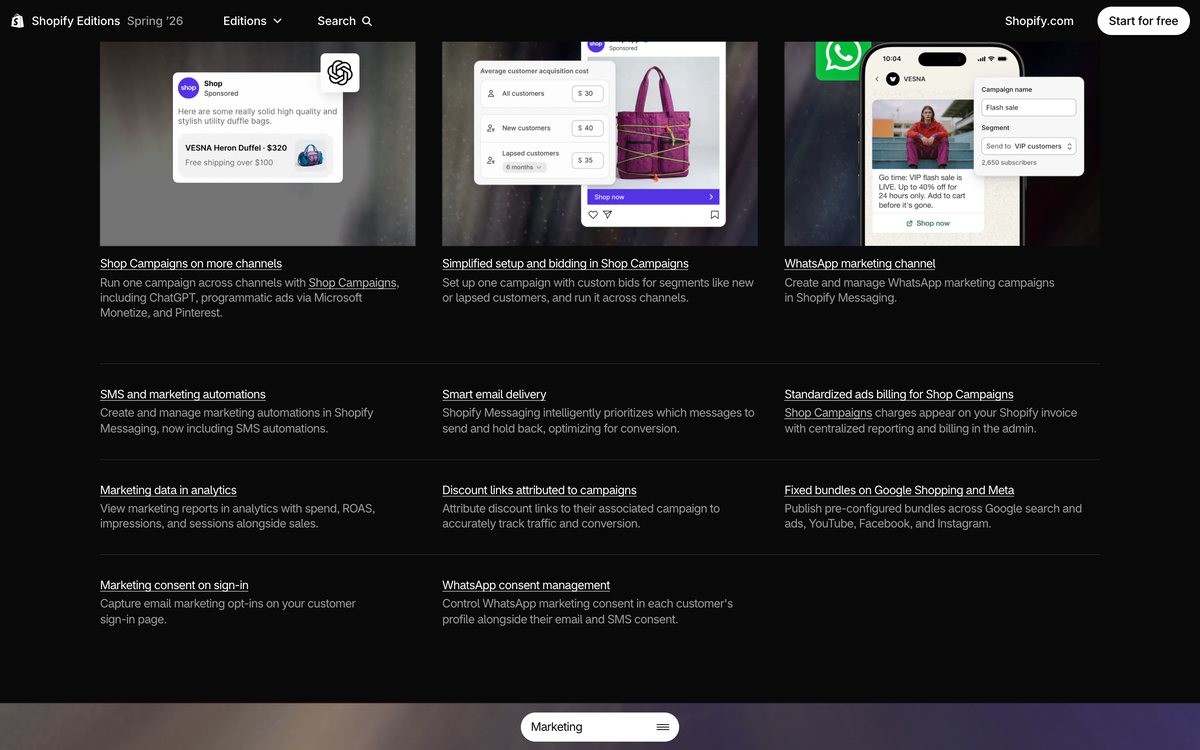 Shop Campaigns across more channels (incl. ChatGPT Ads, Microsoft, Pinterest) plus WhatsApp marketing · source: Shopify Editions
- Sidekick everywhere + Pulse: the AI assistant moves from a side panel to a persistent layer on every admin screen — type or talk, even check business data on Apple Watch. The new Sidekick Pulse turns your sales, traffic, and inventory data into actionable recommendations. It can also auto-create customer profiles from plain language and generate purchase orders with automatic transfers.
- Sidekick App Extensions: already integrated with 15+ top apps including Klaviyo, Loop, Smile, Judge.me, Yotpo — ask Sidekick “how’s my Klaviyo flow revenue?” right in the admin.
- Campaign Autopilot (early access): AI runs marketing on autopilot, learning and optimizing within your guardrails. It starts on Facebook / Instagram / Shop / email. The positioning is refreshingly honest: let small merchants without an agency budget run sophisticated campaigns too.
- AI Sales Associate (Shopify Inbox): AI handles questions, order lookups, and product recommendations from your catalog and inventory — you control tone and human-handoff rules.
- AI store analysis (SimGym): AI-simulated shoppers walk your theme and surface improvement ideas.
🔑 Riven’s read: don’t treat “early access” as “go all in now”
My advice is clear — adopt in three tiers by maturity:
- Use now: Sidekick Extensions (connect the Klaviyo/Loop you already run) and the AI Sales Associate — provided your catalog and policy data are clean. Feed it garbage and the AI confidently makes things up.
- Test on a small budget: Campaign Autopilot is early and channel-limited — run a contained experiment with part of your budget, don’t hand it the whole account day one.
- Lay it as infrastructure: the new analytics charts + Rollouts (native A/B testing + scheduled publishing + automatic rollback) — build your measurement first.
⚠️ A caveat: figures like “20× YoY growth from AI channels” or “AI drove 3.2% of revenue” are mostly merchant-reported and not independently audited by the platform. The trend is real, but don’t treat someone else’s peak as your KPI.
Block 3: Going global — cross-border sellers, read this line by line
The first two blocks are about “the future.” This one is a dividend you can eat today.
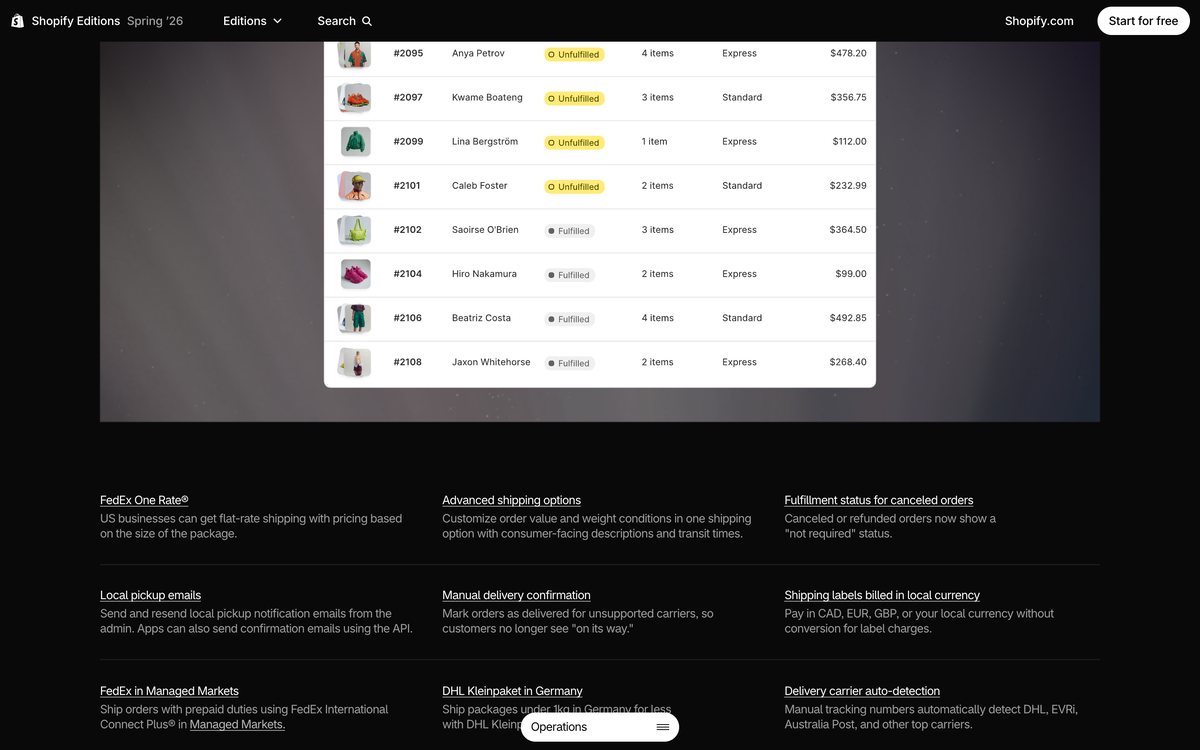 The Operations block — Managed Markets, FedEx One Rate, local-currency shipping labels, DHL Kleinpaket in Germany, and more · source: Shopify Editions
- Managed Markets expands to the UK and Canada: merchants there can now sell globally with duties, taxes, and compliance fully managed — set up in minutes.
- Managed International Pricing: dynamically localized pricing that can bake in duties, taxes, and fees — a direct cure for the biggest cross-border pain, the opaque landed price. You also get a duty calculation breakdown.
- Local-currency gift cards + local-currency labels: sell/redeem gift cards in the customer’s currency; pay shipping directly in CAD / EUR / GBP with no FX.
- B2B on all plans: company profiles, volume pricing, up to three B2B catalogs — free on every plan (previously a higher-tier feature) — plus native QuickBooks / Mailchimp.
- Local logistics in Germany: FedEx Managed Markets and DHL Kleinpaket (parcels under 1kg).
🔑 Riven’s read
For Chinese cross-border sellers, the two most valuable items are Managed International Pricing and the Managed Markets expansion. Half the reason cross-border DTC conversion stalls is “duties show up at checkout and the landed price spikes.” Shopify managing that away pushes your cart-abandonment rate down. And free B2B on all plans opens a free door for anyone doing wholesale/distribution — don’t waste it.
Block 4: Payments & conversion — Shop Pay is going to “other people’s houses”
- Shop Pay on any platform: the big one. Any brand, on any platform, of any size, can now offer Shop Pay at checkout — reaching 250M+ Shop users and one-click buying. Shop Pay goes from “Shopify-only” to “anywhere.”
- Managed Payment Methods: Shopify Payments dynamically orders payment options by likelihood to convert.
- More local methods: MobilePay, TWINT, BLIK, Przelewy24 across more countries; interest-free installments (Meses Sin Intereses) in Mexico.
- Crypto: pay with USDC on Base for automatic cashback, with multi-chain support and auto-bridging.
- Checkout experience: a tighter, higher-converting layout, ship + pickup in one checkout, and EU/UK VAT ID validation.
🔑 Riven’s read
The storyline here is the same as agentic commerce: let the act of “buying” happen anywhere — other platforms, the AI chat box, social ads. Shop Pay everywhere looks like a payments feature, but it’s really Shopify laying its checkout standard across the entire web, pre-positioning for “AI-shelf checkout.”
For builders / developers: the barrier just got cut again
- Hydrogen rebuilt, agent-first: Shopify’s headless framework now works with any frontend stack (including Next.js) and is “AI-first,” so AI tools can generate and modify storefronts more effectively.
- Shopify AI Toolkit: manage your store right inside Claude, ChatGPT, Perplexity, Cursor, VS Code — add products, build collections, manage orders.
- Vibe-coding a store: describe your business in plain language and spin up a store with Manus, Replit, V0, Lovable.
In one line: building a technically solid DTC store has never had a lower barrier, thanks to AI. Which means — “being able to build a store” is no longer the moat; “being seen and recommended by AI” is. Back to GEO again, right?
Riven’s five judgments
- The keyword isn’t “AI features,” it’s “shelf migration.” Catalog + UCP + checkout-in-chat all point to one thing: your products are going to get listed inside AI.
- GEO goes from “nice-to-have” to “table stakes.” When AI becomes the shopping entry point, not being mentioned in AI answers ≈ not existing on the shelf.
- The “can build a store” dividend is over. The technical barrier is flattened; what separates sellers now is brand visibility inside AI and supply chain / product selection.
- The leverage of small teams is reinvented. Whoever puts AI into daily operations first pulls a full body-length ahead on output per head.
- The global compliance/pricing dividend is edible today. Managed International Pricing and the Managed Markets expansion are certain gains — drive your abandonment rate down first.
Five things to do right now
- Clean your product data. Titles, attributes, variants, inventory, compliance info — this is the “raw material” you feed Catalog/AI. Garbage in, hallucination out. Highest ROI step.
- Run a GEO check-up. Go to ChatGPT / Perplexity / Google AI Mode right now, search your core category, and see whether the AI recommends you, how it describes you, and who it cites. The gaps are your to-do list.
- Connect 1–2 Sidekick extensions. Already on Klaviyo / Loop / Yotpo? Wire them into the admin.
- Cross-border sellers: turn on Managed International Pricing. Make duties and taxes in the landed price transparent, and watch your abandonment rate for a week.
- Test Campaign Autopilot on a small budget. Early access, contained experiment — set up A/B measurement with Rollouts first.
Closing
Every Shopify Edition is a roadmap for the next 12 months. Spring ‘26 Edition says it plainly: the commerce of the future happens “everywhere” — especially inside AI conversations.
The shelf is migrating. The traffic entry point is migrating. And what decides whether your brand shows up on the new shelf is whether AI can see you and recommend you. That’s called GEO.
Don’t wait for the ecosystem to fully mature before you move — by then, the first movers who captured the AI-recommendation dividend will have filled the seats.
I’m Riven. See you in the next one.
About the author: Riven writes about cross-border brand growth and GEO (Generative Engine Optimization) in the age of AI search. More at georiven.com.
Sources
- Shopify official: Editions Spring 2026 (shopify.com/editions/spring2026)
- ChannelX: Shopify Editions Spring 2026 – Commerce Everywhere
- Digital Applied: Shopify Spring ‘26 — Sidekick, Autopilot and Store AI
- Related (this site): Shopify GEO & Agentic Commerce — make AI understand, cite, and recommend your brand
- Related (this site): The Agentic Revenue Loop — decoding momcozy’s agents.md and Shop’s SKILL.md, the 5 gates of the AI-agent era