Shopify GEO and Agentic Commerce: Getting AI to Understand, Cite, and Recommend Your Brand (Hangzhou Talk Recap)
This article is adapted from my keynote, “Shopify GEO Marketing in the AI Search Era: From Opportunity Insight to a Closed-Loop Growth Engine,” delivered on May 21, 2026 at the “Shopify Agentic Growth Program · Hangzhou Stop (Smart Home Edition).” The event was co-hosted by Cyberklick and Shopify.
 Figure: Riven presenting “Shopify GEO Marketing in the AI Search Era” at the Hangzhou stop · 2026-05-21
The One-Sentence Thesis: Traffic Entry Points Are Shifting
The traffic entry point for the future of e-commerce is moving from the search results page to the AI conversation. Users no longer just type keywords into a search box and open ten web pages to compare on their own; more and more people ask ChatGPT, Perplexity, or Google AI Overview directly: “Recommend me a product that fits scenario X.”
That changes the core question. It is no longer “Can I be found in search?” but rather: Will AI understand me, cite me, recommend me, and bring the user all the way to buying from me?
The essence of GEO (Generative Engine Optimization) is to make your brand, products, policies, and purchasing capabilities correctly understood by AI, credibly cited, and smoothly advanced toward a transaction.
What GEO Really Is: Claiming Your Brand’s Place in the AI Answer
GEO is not SEO with a new name. It is a new competition for visibility:
| Dimension | Traditional SEO | GEO (Generative Engine Optimization) |
|---|---|---|
| Competitive goal | Ranking on the search results page (Top 10) | Citation, mention, and recommendation eligibility inside the AI answer |
| Core focus | Keywords, pages, backlinks | Brand facts, product data, cross-source consistency |
| Optimization direction | Click-through rate and on-site conversion | Model understanding, trust, and a buyable path |
| Content audience | Primarily human readers | Both humans and machines |
This gives rise to a set of new visibility metrics: Citation Rate, Brand Mention, Answer Share, Recommendation Quality, and Assisted Conversion.
The SEO × GEO Dual Flywheel
GEO is not meant to replace SEO. It adds a second flywheel to brand growth:
- The classic flywheel (still essential): Drive traffic → site experience → on-site conversion (CRO) → return visits. This suits brands with high average order values, strong content operations, and heavy membership programs, and it defends your existing traffic base.
- The new AI flywheel (the new growth engine): Standardized product data → AI-understandable and recommendable across scenarios → conversational conversion → data feedback. Powered by Shopify Agentic capabilities + UCP laying the tracks, it closes the loop of “data → operations → transaction.”
The two flywheels run in parallel without conflict: the first defends your existing base, and the second claims the incremental territory of the AI era.
The Five Search Intents: From Being Searched to Being Cited
The user purchase journey has five intents, and in the GEO era each one must be upgraded from a “traditional SEO action” to an “AI action”:
- Informational (What is…/How to…): from long-tail keywords, FAQs, and Featured Snippets → building an authoritative knowledge base, E-E-A-T content, and semantic structuring;
- Commercial investigation (Best…/… vs …): from review articles, comparison tables, and rankings → multi-dimensional review data, aggregated genuine reviews, and optimized comparison logic;
- Transactional (Buy…/price/discount): from conversion optimization and Schema → standardized product data, price transparency, and Agentic Commerce integration;
- Navigational (brand terms/login): from brand-term protection and Sitelinks → establishing the brand entity, authoritative official information, and sameAs mapping;
- Generative intent (Create a…/Generate…, unique to AI, accounting for about 37.5%): scenario-based content, brand input strategy, and conversational marketing.
In a sentence: brand content must be upgraded from being searched to being cited, and from static information to dynamic solutions—from “telling users what something is” to “helping users do something.”
GEO’s Core Mechanism: First Reduce AI’s Three Uncertainties
Before recommending a brand, AI first answers three questions. A brand’s job is to drive these three uncertainties down:
- Technical Accessibility—“Can I crawl, read, and call this information?” → structured data Schema, product Feed/API, Sitemap & robots friendliness, and Agentic protocol entry points.
- Content Explainability—“Who exactly is this brand/product for, and what problem does it solve?” → Answer-first content, FAQ/comparison pages, specs/scenarios/constraints, and extractable recommendation conclusions.
- Source Trustworthiness—“Why should I trust it and recommend it to users?” → third-party reviews and media, Reddit/communities/forums, citations from authoritative sites, and review consistency.
RAG: The Technical Foundation of GEO
Understanding how AI performs Retrieval-Augmented Generation (RAG) helps you pinpoint where to optimize: Retrieval → semantic Chunking → Generation → Feedback. By embedding signals that are “easier for machines to understand” (code, structure, facts) at each stage, you raise the probability of ultimately being cited. This is not a one-time input but continuous, stage-by-stage optimization.
The GEO Decision Loop: A Shorter Path, but a Longer Preparation Chain
In the AI era the user’s path gets shorter (natural-language need → AI parsing → reading products/content/sources → judging whether the facts are clear and credible → generating a recommendation → confirming purchase), but the brand’s preparation chain gets longer: clear facts and consistent sources → entering the recommendation and transaction loop; vague facts and sparse sources → being skipped by AI and dropped into the competitor candidate set. GEO therefore involves product data, site technology, the customer-service knowledge base, legal policies, PR, and data analytics—it is organization-level collaboration.
Why Shopify Is Ahead on GEO
Shopify is not a “website builder.” It organizes product data, brand knowledge, checkout capabilities, and AI agent protocols into commercial infrastructure that AI can call. Its GEO friendliness is not a single feature but a four-layer AI Commerce architecture:
| Layer | Shopify Component | GEO Value |
|---|---|---|
| Product discovery layer | Catalog (title/description/images, category/variants, price/inventory) | Lets products, prices, inventory, and variants be retrieved and recommended by AI |
| Brand explanation layer | Knowledge Base (shipping/returns/warranty, compatibility, purchase decisions) | Answers “why buy from you, is it right for me, what if I bought the wrong thing” |
| Agentic transaction layer | Agentic Storefronts + Checkout | Advances from an AI recommendation to a real purchase and after-sales service |
| Machine discovery layer | UCP / MCP / Agentic API | Lets AI agents recognize the merchant’s capabilities, tools, and checkout boundaries |
 Figure: The Shopify Greater China team presenting Shopify’s AI Commerce capabilities on stage
Catalog: The Product Page of the Future Must First Become Data That AI Can Read
AI won’t repeatedly flip through your pages; if the title, specs, variants, inventory, and policies aren’t clear, it is more likely to pick someone else. Transform your marketing title into a parseable title: category + key attributes + intended user + specs. For example: Mid-Century Walnut TV Stand for 65–75″ TVs, Cable Mgmt, 60″W. In the description, spell out material/dimensions/compatibility/scenario/constraints; standardize variants (Color/Size/Model); and fill in GTIN/UPC to improve cross-platform and AI product matching.
Knowledge Base: GEO Content Is Not About Writing More Articles—It’s About Supplying the Facts AI Needs to Answer
Turn customer service, policies, and product explanations into stable, updatable brand facts that AI can read: shipping, returns and exchanges, warranty, compatibility, safety/materials, and purchase decisions—exactly the questions AI is most frequently asked.
How Merchants Execute: From Prompt to Asset to Source
Prompt Tracks and Source Strategy
AI does not trust a brand talking about itself; it trusts facts that are consistent across multiple sources. Run your Prompts on separate tracks:
- Track A – Informational → goal Citation Rate: educational/knowledge content, analysis of authoritative citation sources, competing to be cited;
- Track B – Commercial investigation → goal Brand Mention: deconstructing competitor/recommendation pages, building relationships with media reviews and rankings, competing to be compared side by side;
- Track C – Generative → goal recommendation-conclusion mention: Answer-first content, FAQ + extractable conclusions, competing to be recommended directly.
Transactional/verification/navigational Prompts are not prioritized in the first wave (low ROI, already covered by the brand’s existing channels, and little room for AI to rewrite).
Audit First, Then Write Content
The first step is not writing content but taking inventory of whether the facts AI reads are complete. P0 items: Agentic Channel setup, core SKU titles, product descriptions, variants/prices/inventory, Knowledge Base, and policy consistency; P1 items: images and Alt Text, Collection structure, third-party sources, and monitoring metrics.
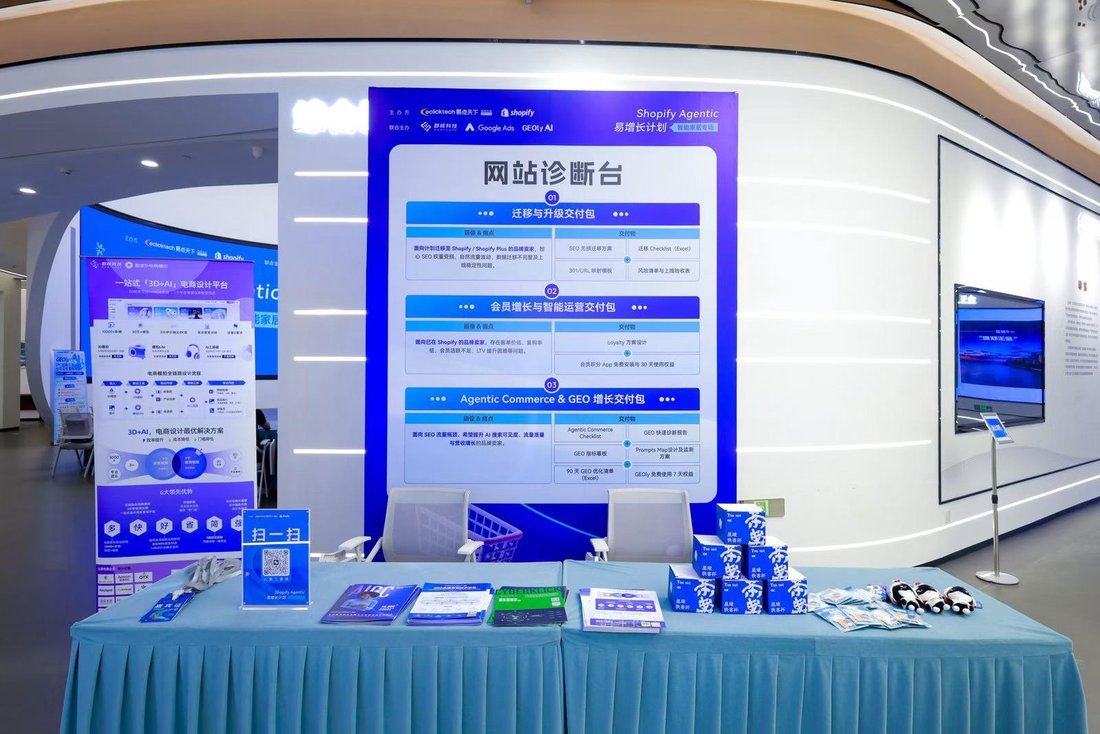 Figure: The on-site “website diagnostics station”—Migration & Upgrade Package, Agentic Ready Package, and Membership Growth Package
The 90-Day Implementation Roadmap
- Phase 1 (Days 0–30) Foundation inventory and quick fixes: Agentic channel and Catalog inventory, core SKU field audit and P0 fixes, title/description/variant/policy alignment, Knowledge Base high-frequency FAQ v1;
- Phase 2 (Days 31–60) Structuring and testing: Catalog mapping & metafields, high-intent Prompt test matrix, restructuring Collections by purchase intent, first round of on-site content optimization;
- Phase 3 (Days 61–90) Sources and governance: off-site sources (PR/Reddit/media), AI-channel performance dashboard, GEO checklist for new product launches, and a weekly GEO Review SOP.
How to Measure: A Three-Layer KPI of Visibility · Traffic · Revenue
GEO evaluation should connect “whether AI has discovered you, recommended you, generated orders, and whether the order quality is better”:
- Visibility: Citation Rate, Brand Mention Rate, Query Coverage, Recommendation Quality;
- Transaction: AI-referred Sessions, AI Channel Orders, Assisted CVR/AOV, Direct Checkout Rate;
- Quality: Return/Refund Rate, Support Contact Rate, Negative Mention, Net Promoter (AI).
Together with traditional SEO metrics (GSC impressions/rankings, GA4 traffic/revenue), they form a complete data attribution loop.
Closing: AI Won’t Wait for Brands to Get Ready
Be understood before you can be cited; be trusted before you can be recommended; be buyable before you can turn AI traffic into revenue.
The action plan is simple: immediately run a Catalog & KB inventory and lock down P0; within 30 days fix core SKUs and high-frequency FAQs; within 90 days enter the Prompt + source loop and build an AI-channel performance dashboard with weekly reviews. The sooner you organize machine-readable commercial facts, the sooner you capture the AI-channel dividend.
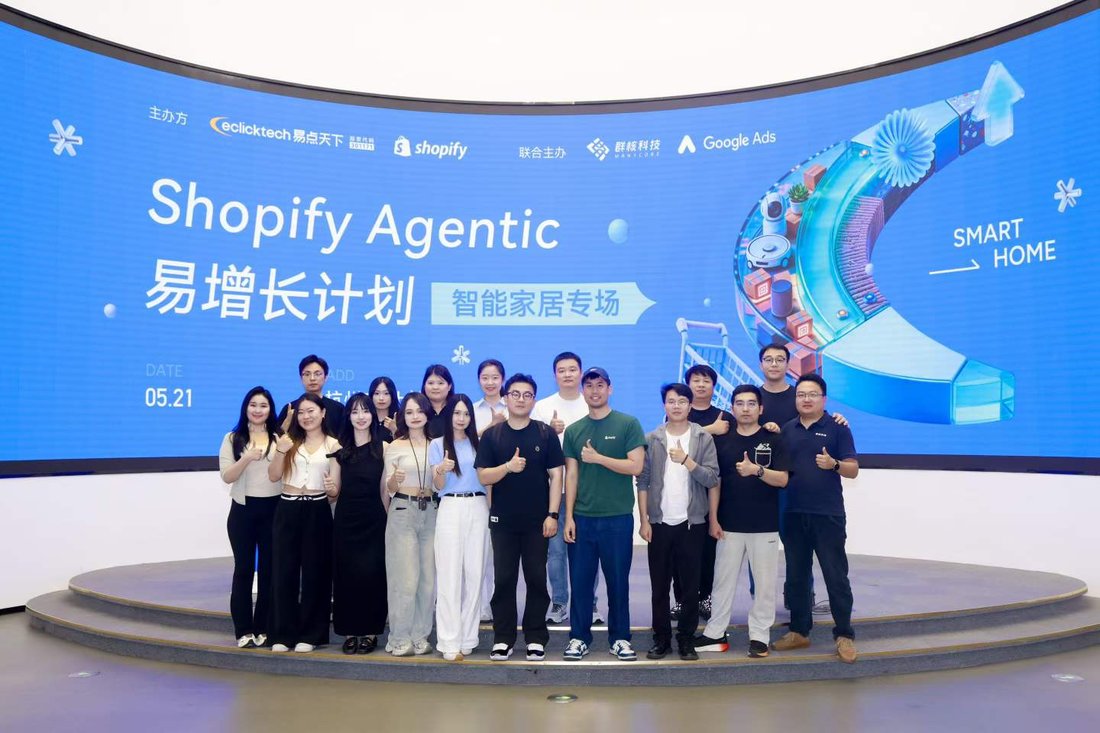 Figure: Group photo of guests at the Shopify Agentic Growth Program · Hangzhou Smart Home Edition
📌 This article is adapted from the Hangzhou keynote. For event details, the full agenda, and on-site delivery packages, see: Shopify Agentic Growth Program · Hangzhou Stop. To learn about your brand’s visibility in AI search, check out the GEO Reports or the GEO Academy courses.
🔗 Further reading: Shopify Editions Spring 2026, Decoded: Behind 150+ Updates, Only One Storyline Matters for Global Ecommerce Brands — a full breakdown of Agentic Commerce, the Universal Commerce Protocol, and Shop Pay everywhere.